Jewelry District
los angeles, united states
A dazzling daytime destination for jewelry hunters and history lovers, the Jewelry District rewards bold solo shoppers — but keep your visit strictly to business hours, as this commercial enclave transforms after dark.
Stats
Key Safety Tips
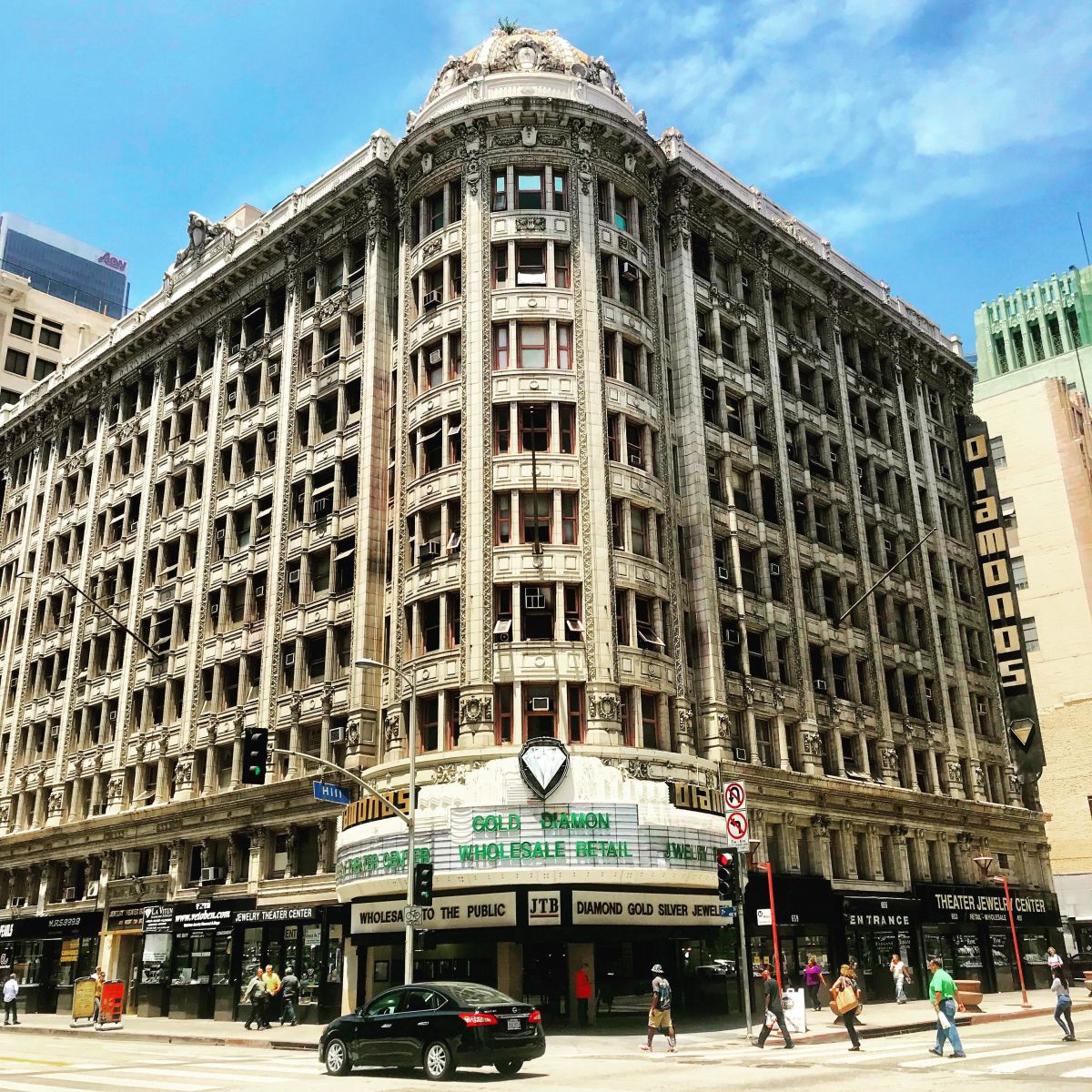
The Jewelry District in Downtown Los Angeles occupies a compact grid of historic early twentieth-century buildings between Hill Street, Broadway, 5th Street, and 8th Street — and if you have ever wanted to spend an afternoon hunting for a diamond, a custom engagement ring, or a bold statement piece at wholesale prices, this is your destination. The district came into its own after the 1960s, when gold emerged as a preferred investment and the density of jewelers transformed these blocks into one of the most concentrated retail jewelry markets in the United States. Today, hundreds of dealers operate out of buildings that date to the 1920s, many of them family-run businesses passing expertise down through generations. For the solo female traveler, the appeal is pragmatic and atmospheric in equal measure: the buzz of negotiation, the sparkle of display cases lining every corridor, and the faded grandeur of buildings like the Loew's State Theatre at 703 S. Broadway and the Jasper Building on Hill Street. St. Vincent Jewelry Center at 607 S. Hill Street is the district's anchor — a multi-level complex housed in the former Bullock's building with a European-inspired alley of cafés and dozens of vendors. The California Jewelry Mart and International Jewelry Center are also within steps. This is a daytime district, purposeful and commercial, and that focus actually makes it more navigable for solo travelers: vendors are there to sell, not to hassle.
Walking the Jewelry District during business hours — roughly 9 AM to 6 PM Monday through Saturday — is genuinely pleasant. Hill Street is the main artery, lined with glittering window displays and hawkers standing outside doorways calling out greetings. The blocks between 5th and 8th are compact enough that you can cover the core in under an hour of casual browsing. Broadway runs parallel and connects you to the Historic Core's other attractions including the Grand Central Market at 317 S. Broadway, only a few blocks north. Sidewalks are wide and well-trafficked during peak hours. However, this seasoned traveler advises being aware of the broader DTLA context: the area borders some of Downtown's more challenging blocks, and the intersection of 6th and Main to the east sees higher concentrations of unhoused individuals. Stick to Hill Street, Broadway, and 7th Street during your exploration. Wear comfortable shoes — the sidewalks are uneven in places on the older blocks. Keep your bag zipped and worn in front in the crowded indoor markets. Street harassment is not a significant feature of this commercial zone; the vendors are focused on business, and the daytime foot traffic keeps energy purposeful.
The Jewelry District operates on a traditional retail schedule shaped by its wholesale roots. Most storefronts and indoor market stalls are open Monday through Friday from 9 AM to 6 PM, with Saturday hours typically 9 AM to 5 PM. St. Vincent Jewelry Center at 607 S. Hill Street keeps similar hours. The California Jewelry Mart and International Jewelry Center open slightly later on some days, around 10 AM. Sunday is largely closed — many vendors are observant of religious rest days, and the district is noticeably quieter to the point of being deserted. The cafés inside St. Vincent's tend to open around 8:30 AM to catch the early trade. If you're planning a serious shopping session, arrive on a weekday morning when stock is freshest, vendors are most engaged, and the indoor alleys have not yet become crowded with lunchtime browsers. Many vendors close for lunch from roughly 1 PM to 2 PM. Bank holidays can cause closures with little advance notice, so check before making a dedicated trip.
Dining options within the Jewelry District itself are modest but functional. The most notable food option is the café alley inside St. Vincent Jewelry Center at 607 S. Hill Street, which features a handful of counters serving sandwiches, wraps, espresso, and quick lunches — the sort of place jewelry dealers duck into between appointments. Prices here are reasonable, roughly –4 for a full lunch. For more variety, the nearby Grand Central Market at 317 S. Broadway is a five-minute walk north and offers one of Downtown LA's best food hall experiences, with stalls serving everything from Filipino breakfast to Guatemalan tamales to artisan tacos, with most dishes priced 0–8. Clifton's Republic at 648 S. Broadway, a historic cafeteria turned casual eatery, is another nearby option. For coffee, Alchemist Coffee Project on Broadway draws a creative crowd. Solo dining is entirely normalised in this area — the lunch crowd is largely composed of professionals, workers, and shoppers eating on the go. Halal and kosher options are available from several vendors catering to the district's diverse community of dealers.
Haggling is not only accepted in the Jewelry District — it is expected. This is a wholesale-rooted market, and the prices you see in display cases are rarely the final price. Many women find that entering this environment alone can invite either extra attention or extra respect depending on the vendor, and the best approach is to be direct and confident about your budget. Know roughly what you want before you walk in: do a quick search for retail comparisons online before your visit. It is entirely normal to ask "what's your best price?" after expressing genuine interest. Do not feel obligated to buy after spending time looking at pieces — browsing is part of the culture. Vendors at St. Vincent Jewelry Center and California Jewelry Mart are generally accustomed to international buyers and are professional in their approach to negotiation. Avoid haggling aggressively on pieces priced under 0 — reserve your negotiating energy for larger purchases. Custom work and repairs are negotiable too, and the district is an excellent place to have jewelry appraised or resized at competitive rates.
The nearest hospital to the Jewelry District is Good Samaritan Hospital at 1225 Wilshire Boulevard, approximately one mile west and accessible by a 5-minute Uber or the Metro. It has a full emergency department and is one of DTLA's primary trauma-capable facilities. California Hospital Medical Center is located at 1401 S. Grand Avenue, roughly a 10-minute walk or 5-minute drive south. For urgent care that does not require a full emergency visit, several clinics operate in the broader Downtown area. The Los Angeles County + USC Medical Center is the major public hospital farther east, accessible via the Metro Gold Line. Pharmacies are available within walking distance — there is a CVS within the FIGat7th complex on 7th and Figueroa, a 10-minute walk west. In any emergency, call 911; LAPD Central Division covers this area and response times are generally reasonable during daytime hours.
Tap water in Los Angeles is treated, tested, and safe to drink by US federal standards. The city's water supply comes primarily from the Metropolitan Water District and meets EPA standards. That said, many Los Angeles residents prefer filtered water, and some older building plumbing in the Jewelry District's early twentieth-century structures can affect taste. Bringing a reusable water bottle with a filter (such as a Brita-style) is a practical choice if you're sensitive to water taste. Bottled water is available at convenience stores on Hill Street and Broadway, as well as from vendors inside St. Vincent Jewelry Center. Public drinking fountains are scarce in this part of Downtown, so staying hydrated means planning ahead. Most cafés and food stalls will refill a water bottle on request. Dehydration is a real risk in LA's dry climate, especially in summer when temperatures can exceed 95°F — carry water even on short excursions.
California's alcohol laws are permissive by international standards. The legal drinking age is 21, and ID is required at all venues serving alcohol. Alcohol can be purchased at licensed supermarkets, liquor stores, and bars seven days a week. The Jewelry District itself has few bars — it is a commercial retail zone with almost no nightlife infrastructure. The nearest wine bars and cocktail bars are in neighboring areas: the Arts District to the east, or the Historic Core bars around Broadway and Spring Street. Open container laws prohibit drinking alcohol on public sidewalks and streets, so purchasing from a liquor store and drinking while walking is illegal and may draw police attention. Alcohol is served in the cafés at Grand Central Market (317 S. Broadway) from late morning onwards. The broader DTLA area is well-supplied with bars; the Jewelry District simply isn't one of them. If you want a drink after shopping, head to Tony's Saloon at 512 E. 4th Street in the Arts District or one of the rooftop bars at nearby DTLA hotels.
Los Angeles, and the Jewelry District in particular, reflects a highly multicultural social fabric. The district's dealers include communities of Persian, Armenian, Korean, Latino, Jewish, and Middle Eastern backgrounds, among others. Greetings are informal in the American style — a friendly "hi" or "hello" suffices universally. Some vendors may greet you in Farsi, Spanish, Hebrew, or Armenian; responding with a smile and English is perfectly fine. There is no expectation of formal greetings or bowing. Handshakes happen in more formal purchasing contexts when a deal is being concluded. Many vendors are warm and social; it is entirely normal to have a brief conversation about where you're from or what you're looking for before getting into business. As a solo female traveler, expect to be treated as a capable buyer — the best vendors will quickly read your level of interest and adjust their pitch accordingly. Avoid being dismissive in your greetings; warmth goes a long way in building rapport that can translate to better prices.
The Jewelry District operates on relaxed LA time for casual browsing, but punctuality matters if you have arranged a specific appointment for custom work, appraisal, or a repair pickup. Vendors are generally ready to do business at opening time, so arriving at 9 AM when the doors open is a good strategy for unhurried attention. The lunch slowdown between roughly 1 PM and 2 PM can mean vendors are briefly unavailable or distracted. For repairs or custom orders, confirm your pickup time by phone on the day rather than assuming — small workshops can run behind. Los Angeles generally operates on a casualized sense of time, and ten or fifteen minutes of variance on informal arrangements is not unusual. If you have been quoted a "one hour" wait for a repair, mentally budget ninety minutes. The Metro B Line to Pershing Square runs on a predictable schedule, so factoring in transit time is more reliable than estimating driving time given LA traffic.
The Jewelry District is not primarily a social destination — it is a commercial one — but the concentrated, conversational nature of the trade creates natural opportunities to connect. Vendors are often happy to talk about their craft, their stones, their family histories in the trade. If you are genuinely interested in jewelry, this enthusiasm is a real social bridge. The café alley inside St. Vincent Jewelry Center is a natural gathering point; this seasoned traveler has found that striking up conversation over coffee with another shopper or a vendor on break can yield unexpectedly informative discussions about where to find the best deals. For meeting other solo travelers or locals more broadly, the Grand Central Market a few blocks north is far more of a social hub — its communal tables and diverse vendor community make it one of Downtown LA's best places to accidentally make friends. The nearby Spring Arts Collective and Arts District co-working spaces attract a younger creative demographic. Apps like Meetup list regular events in DTLA for newcomers and solo visitors.